Definium Therapeutics announced positive topline results from Voyage, a Phase 3 study evaluating a single 100 mcg dose of DT120 (lysergide) orally disintegrating tablet (ODT) in adults with generalized anxiety disorder (GAD). The study met its primary endpoint and all three multiplicity-controlled key secondary endpoints.
DT120 ODT is Definium's proprietary formulation of lysergide, also known as LSD, a classic serotonergic psychedelic. Lysergide acts as a partial agonist at serotonin 5-HT2A receptors.
Although its acute perceptual, cognitive, and affective effects are mediated by 5-HT2A receptor agonism, the precise mechanism responsible for a sustained therapeutic effect in psychiatric disorders remains unknown. The company reports that the ODT formulation is designed for rapid absorption and onset. DT120 has received FDA Breakthrough Therapy designation for GAD.
Voyage Study Design
Voyage is a multicenter, randomized, double-blind, placebo-controlled Phase 3 study conducted at approximately 35 sites in the United States. It enrolled 214 adults, ages 18 to 74 years, with a DSM-5-confirmed diagnosis of GAD and a Hamilton Anxiety Rating Scale (HAM-A) total score of at least 20 at screening and baseline. Participants were randomized to receive a single dose of DT120 ODT 100 mcg or placebo.
The study includes a 12-week double-blind period (Part A), followed by a 40-week open-label extension (Part B). During Part B, eligible participants may receive up to four additional doses based on symptom severity.
| Population |
Treatment |
Primary Endpoint |
Key Secondary Endpoints |
| 214 adults, ages 18-74; DSM-5 GAD; baseline HAM-A at least 20 |
Single DT120 ODT 100 mcg dose or placebo |
Change in HAM-A at Week 12 |
CGI-S Week 12; HAM-A Week 1; CGI-S Day 2 |
Efficacy Results
The mean baseline HAM-A score was 28.4 in the DT120 ODT group (n=107) and 27.4 in the placebo group (n=107). At Week 12, the least-squares mean change in HAM-A total score was -11.6 with DT120 ODT and -6.2 with placebo. The company reported separation from placebo as early as Day 2, with improvement sustained at all post-baseline assessments in Part A.
Mean Change in HAM-A Total Score at Week 12
Greater reduction is better
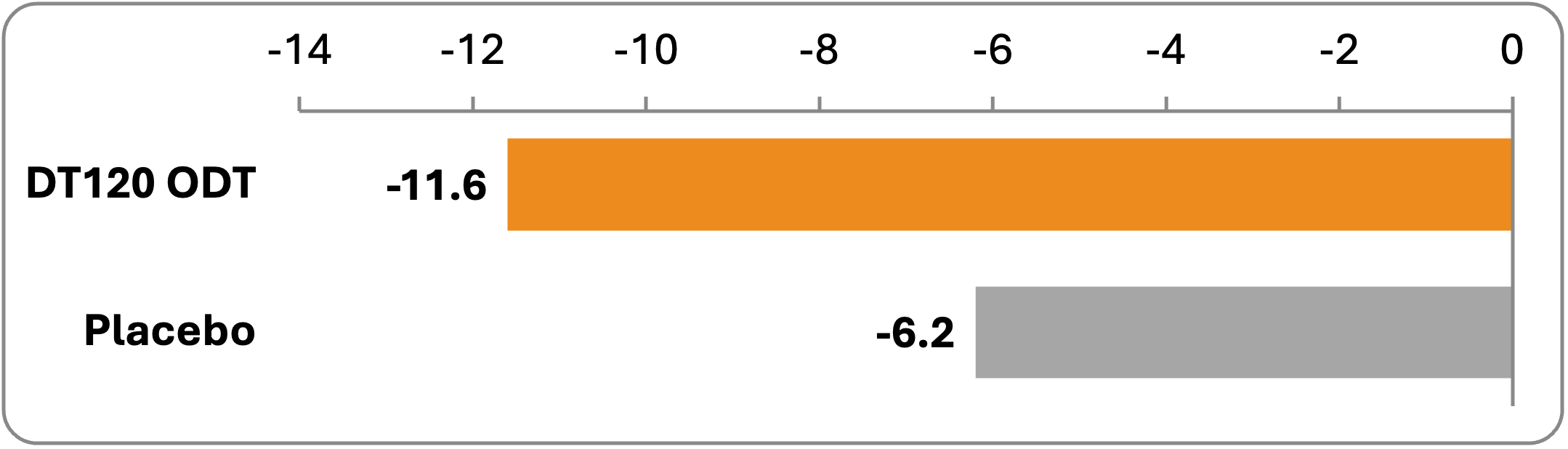
Placebo-adjusted difference: -5.4 points (p<0.0001; Cohen's d=0.81)
| Endpoint |
DT120 ODT 100 mcg |
Placebo |
Placebo-Adjusted Result |
| HAM-A change at Week 12 (Primary Endpoint) |
-11.6 |
-6.2 |
-5.4 (p<0.0001) |
| CGI-S change at Week 12 (Key Secondary Endpoint) |
-1.0 |
-0.4 |
-0.6 (p<0.0001) |
| HAM-A change at Week 1 (Key Secondary Endpoint) |
-11.9 |
-4.2 |
-7.7 (p<0.0001) |
| CGI-S change at Day 2 (Key Secondary Endpoint) |
-1.0 |
-0.2 |
-0.8 (p<0.0001) |
| HAM-A response at Week 12 (at least 50% reduction) (Other Secondary Endpoint) |
43% |
16% |
+27 percentage points (p<0.0001) |
| HAM-A remission at Week 12 (score 7 or lower) (Other Secondary Endpoint) |
14% |
4% |
+10 percentage points (p=0.0222) |
| HAM-A mild or better at Week 12 (score below 16) (Other Secondary Endpoint) |
51% |
23% |
+28 percentage points (p<0.0001) |
HAM-A = Hamilton Anxiety Rating Scale; CGI-S = Clinical Global Impression-Severity; response and remission definitions are from the company release.
Safety and Treatment-Session Observations
According to the topline release, DT120 ODT was generally well tolerated. Treatment-emergent adverse events were described as mild to moderate, transient, and predominantly limited to the day of dosing. No new safety signals were identified, including no signal for suicidal ideation or suicidal behavior.
Participants were assessed hourly beginning five hours after dosing using a structured end-of-session checklist. In the DT120 ODT group, the average time to meet end-of-session criteria was 6.4 hours, the median was 6.1 hours, and 92% of participants met the criteria by Hour 8.
The release did not provide a detailed adverse-event table, discontinuation rates, or longer-term safety findings from the open-label extension. Those data will be important for understanding tolerability, monitoring needs, and the practical requirements of treatment delivery.
Clinical Perspective
A single-dose intervention associated with improvement through 12 weeks would represent a substantially different treatment model from currently available daily pharmacotherapies for GAD. The magnitude and early onset of the company-reported effect are notable, particularly because the Week 12 standardized effect size was 0.81.
However, these findings are preliminary topline results from a company press release and have not yet been evaluated in a full peer-reviewed report. DT120 ODT was compared with placebo rather than an active treatment. In addition, acute psychoactive effects can make treatment assignment easier to guess in psychedelic trials, potentially affecting expectancy and blinding.
Definium is conducting a second pivotal Phase 3 GAD study, Panorama. That study uses a 2:1:2 randomization to DT120 ODT 100 mcg, DT120 ODT 50 mcg, or placebo; the lower-dose arm is intended to make dose assignment more difficult to identify. Results from Panorama, complete Voyage safety analyses, durability and repeat-dosing data from the open-label extension, and details of any FDA submission will help determine whether the Voyage findings translate into a safe, effective, and feasible treatment option.
CLINICAL TAKEAWAY
Voyage provides positive Phase 3 evidence for rapid and sustained symptom reduction after a single 100 mcg dose of DT120 ODT, but replication, complete safety reporting, peer review, and regulatory review remain necessary before the treatment's clinical role can be established.
Additional Education and Resources: