MapLight Therapeutics has announced positive topline results from the phase 2 ZEPHYR trial evaluating ML-007C-MA in adults with an acute exacerbation of schizophrenia. ML-007C-MA is an oral, extended-release, fixed-dose combination of betovumeline, an investigational M1/M4 muscarinic agonist, and fesoterodine, a peripherally acting anticholinergic intended to reduce peripheral cholinergic adverse effects.
ZEPHYR was a randomized, double-blind, placebo-controlled trial conducted at 25 sites in the United States. A total of 307 adult inpatients were randomized 1:1:1 to receive placebo, ML-007C-MA 210/3 mg twice daily, or ML-007C-MA 330/6 mg once daily for 5 weeks. The primary endpoint was change from baseline in Positive and Negative Syndrome Scale (PANSS) total score at Week 5. Key secondary endpoints included changes in Clinical Global Impression–Severity (CGI-S) score and PANSS Marder positive and negative factor scores.
The trial met its primary endpoint with the 210/3 mg twice-daily dose. In the modified intent-to-treat population, ML-007C-MA produced a 4.5-point greater reduction in PANSS total score compared with placebo at Week 5, corresponding to an effect size of 0.37 (P=0.015). Among participants who completed 5 weeks of treatment, the least-squares mean difference versus placebo was -6.0 points, with an effect size of 0.50 (P=0.002).
Primary endpoint: PANSS total score favored BID dosing
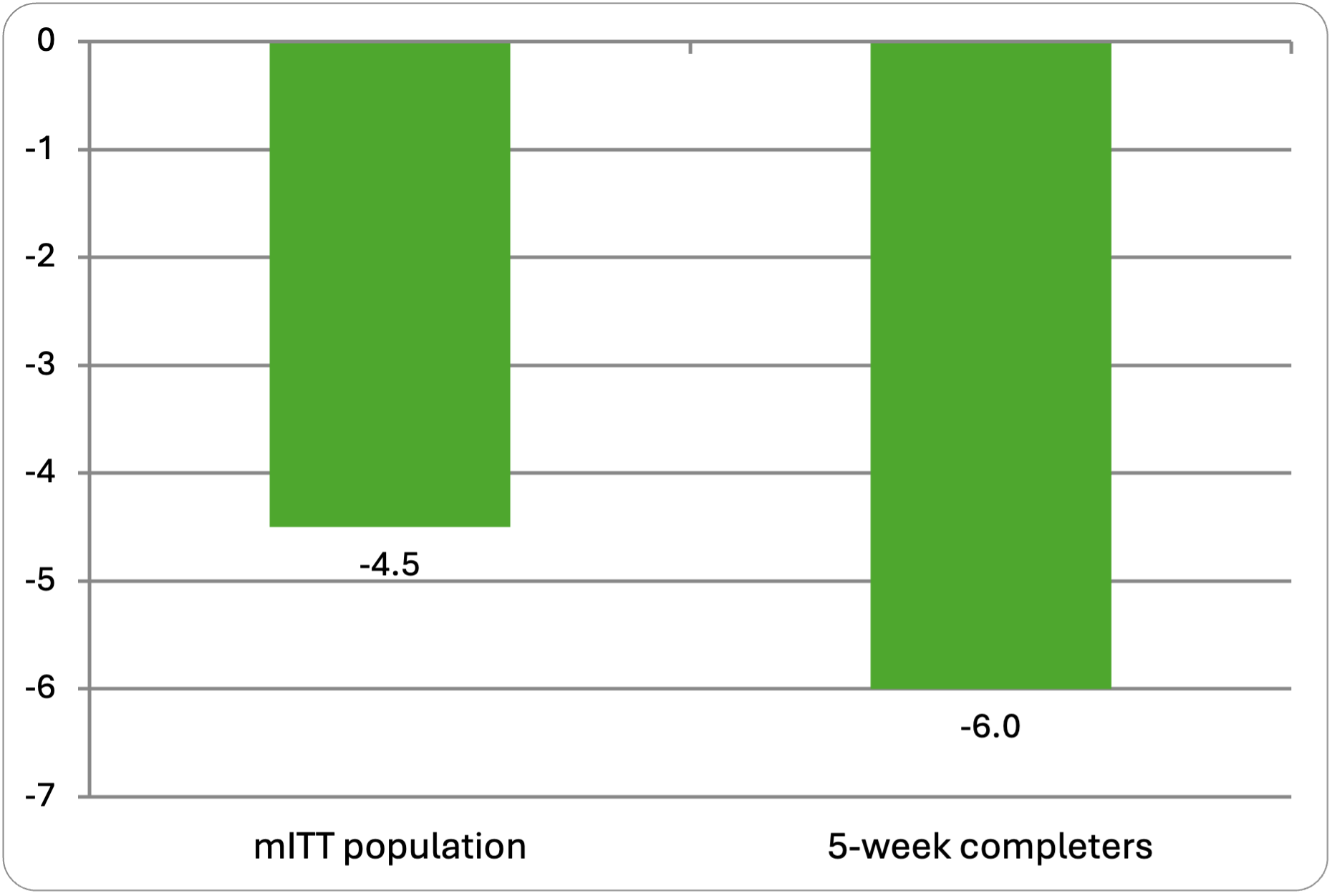
Lower values indicate greater improvement versus placebo at Week 5.
The twice-daily dose also demonstrated statistically significant improvements on several secondary endpoints:
- CGI-S: effect size 0.48 (P=0.002)
- PANSS positive Marder factor: effect size 0.39 (P=0.012)
- Cognitive performance in participants with baseline cognitive impairment: effect size 0.51, with a 0.44-point improvement versus placebo (P=0.041)
The improvement in cognitive performance did not correlate with the change in PANSS score, suggesting that the cognitive effect may have occurred independently of improvement in psychotic symptoms. Cognitive impairment is common in schizophrenia, but no treatment is currently approved specifically for this domain.
The 330/6 mg once-daily dose produced numerical improvement in PANSS total score but did not meet the primary endpoint. It did, however, demonstrate statistically significant separation from placebo on CGI-S, the PANSS positive Marder factor, and the Readiness for Discharge Questionnaire. MapLight is conducting additional analyses to determine whether a once-daily regimen should be advanced.
Safety and Tolerability
ML-007C-MA was generally well tolerated at both doses. Treatment-emergent adverse events were mostly mild and primarily cholinergic in nature. There were no serious adverse events or drug-related severe adverse events in either active-treatment group.
At the 210/3 mg twice-daily dose, treatment-emergent adverse events occurred in 74.7% of participants, compared with 48.1% receiving placebo. Gastrointestinal adverse events were generally mild and led to discontinuation in two participants, or 2.0%. No participant was unable to reach the target dose because of tolerability.
No clinically meaningful signals were observed for urinary retention, metabolic or hepatic parameters, extrapyramidal symptoms, or blood pressure. Small increases in heart rate were observed, consistent with the known pharmacologic profile of fesoterodine. The regimen does not require fasting and uses a brief, one-dose titration.
MapLight plans to meet with the FDA at an End-of-Phase 2 meeting to discuss the development pathway for ML-007C-MA. The company is preparing an additional confirmatory trial that, together with ZEPHYR, may support a future New Drug Application.
Mechanism of Action
- Betovumeline activates M1 and M4 muscarinic acetylcholine receptors in the central nervous system.
- M1 and M4 receptor activation may modulate neural circuits involved in psychosis without directly blocking dopamine receptors.
- Fesoterodine acts as a peripheral anticholinergic and is included to reduce peripheral cholinergic adverse effects associated with muscarinic agonism.
- The extended-release formulation is designed to synchronize exposure to the central muscarinic agonist and peripheral anticholinergic components.
The investigational approach is conceptually similar to other muscarinic agonist–peripheral antimuscarinic combinations developed for schizophrenia, although ML-007C-MA contains different active components and remains investigational.
Additional Education and Practice Resources