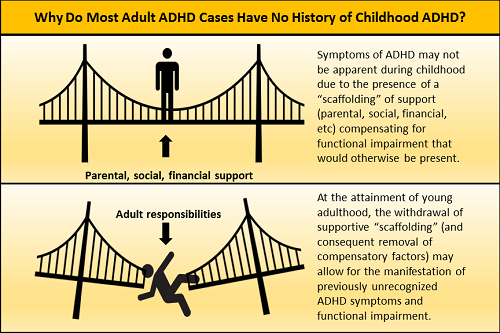
Two recent studies, both published in JAMA Psychiatry, have shed new light on the prevalence, prospective disease course, and emergence of attention deficit hyperactivity disorder (ADHD) in young adulthood. In the first study of over 2000 individuals, Agnew-Blais and colleagues found that only 21.9% of patients diagnosed with childhood ADHD continued to meet ADHD diagnostic criteria as young adults (age 18 years). Conversely, among individuals with adult ADHD (age 18), the vast majority (67.5%) did not meet diagnostic criteria for ADHD during childhood. The second study (including over 5200 individuals) conducted by Caye et al, had similar results; only 17.2% of individuals with childhood ADHD met diagnostic criteria as adults (age 18-19 years) and 87.4% of adults meeting criteria for ADHD did not meet criteria during childhood. The authors of both studies had varying conclusions about these results, including the idea of adult ADHD being a disorder distinct from childhood ADHD with different etiologies. However, one of the most compelling analyses of these studies can be found in the editorial by Faraone and Biederman. These authors propose that the emergence of ADHD in young adulthood might reflect the loss of supportive "scaffolding" present during childhood. In this sense, ADHD may indeed be present in childhood but without overt manifestation of symptoms because parental and social support are enough to compensate for symptom-associated functional impairment. Once the individual reaches young adulthood and that supportive "scaffolding" is removed, symptoms are revealed and greatly affect ability to function (see Figure). Regardless of which conclusion(s) may be correct, it is clear that adult-emergent ADHD warrants further study and that adults who present with symptoms of ADHD that impair daily functioning should be treated whether or not ADHD was ever recognized during their childhood.
References
Agnew-Blais JC et al. JAMA Psychiatry 2016;73(7):713-20.
Caye A et al. JAMA Psychiatry 2016;73(7):705-12.
Faraone SV, Biederman J. JAMA Psychiatry 2016;73(7):655-6.