Orexin A and orexin B are neuropeptides produced by neurons concentrated in the lateral hypothalamus that project widely throughout the brain (Figure). In addition to promoting and maintaining wakefulness, the orexin system engages neural circuits involved in attention, cognition, motivation, reward, and mood. These functions provide a biological rationale for investigating orexin receptor agonism in attention-deficit/hyperactivity disorder (ADHD), although the clinical role of this pathway in ADHD remains uncertain. ALKS 7290 is an investigational oral orexin-2 receptor agonist being developed for adults with ADHD.
Alkermes reported topline findings from a phase 1 program that evaluated ALKS 7290 in 88 healthy volunteers and 50 adults with ADHD. The proof-of-concept phase 1b portion was a double-blind, placebo-controlled, parallel-group study involving two cohorts. Following a 2-week washout of existing ADHD medications, participants were randomized within each cohort in a 4:1 ratio to receive ALKS 7290 or placebo. Participants received total daily doses of 20 mg (n=20) or 50 mg (n=20), administered in split doses, or placebo (n=10) for 14 days in an inpatient setting. Safety and tolerability were the primary objectives, while pharmacokinetics, pharmacodynamics, ADHD symptoms, EEG biomarkers, and cognitive performance were evaluated as exploratory outcomes. The study was not designed or powered to detect statistically significant differences between treatment groups.
ADHD symptoms were assessed using the Adult ADHD Investigator Symptom Rating Scale (AISRS), an 18-item clinician-administered scale corresponding to 9 inattentive and 9 hyperactive/impulsive symptoms. Each item is rated from 0 to 3, producing a total score from 0 to 54, with higher scores indicating greater symptom severity. A validation analysis involving adults with ADHD found that the AISRS had good reliability, validity, and responsiveness to treatment. In that analysis, a 12.5-point within-treatment reduction and a 10.1-point difference between treatments were estimated to represent minimally clinically important changes in the total score.
Participants in the ALKS 7290 study had a median AISRS total score of approximately 39 at baseline. At day 14, median AISRS reductions from baseline were 14 points with the 20-mg dose and 19 points with the 50-mg dose. Improvements were reported by day 6 and across both the inattentive and hyperactive/impulsive subscales. The observed within-group reductions were numerically greater than the 12.5-point within-treatment threshold estimated in the AISRS validation study. However, that comparison is indirect because the validation threshold was derived from mean changes over six months in an atomoxetine trial, whereas the ALKS 7290 results represent median changes after 14 days. Most importantly, Alkermes did not disclose the placebo-group AISRS change, confidence intervals, or between-group statistical comparisons. It is therefore not possible to determine the placebo-adjusted treatment effect or whether the previously estimated between-treatment threshold was met.
Median Clinical Global Impression-Severity scores declined by 1 point with the 20-mg dose and 2 points with the 50-mg dose. Alkermes also reported treatment effects on EEG-based biomarkers and cognitive assessments of processing speed, information processing, working memory, and attention. However, numerical results from the EEG and cognitive measures were not disclosed. These findings should therefore be considered preliminary and hypothesis-generating.
ALKS 7290 was generally well tolerated during the 14-day treatment period. No serious treatment-emergent adverse events were reported, and most adverse events were mild. Events occurring in at least 10% of ALKS 7290-treated participants included insomnia, pollakiuria, dizziness, change in sustained attention, micturition urgency, and constipation. No clinically significant hepatic, renal, vital-sign, or electrocardiographic findings were reported. No participants receiving ALKS 7290 discontinued treatment, compared with two participants receiving placebo. However, adverse-event frequencies by dose and placebo group were not provided, and the small sample and short exposure period preclude conclusions regarding longer-term safety.
These early results suggest that orexin-2 receptor agonism may influence symptoms and cognitive domains relevant to ADHD. However, the findings do not yet establish efficacy because symptom outcomes were exploratory, the trial was not powered for between-group comparisons, and placebo results were not disclosed. A randomized phase 2 study, NCT07755410, is evaluating three ALKS 7290 dosing regimens against placebo in approximately 312 adults with ADHD. Its primary endpoint is the placebo-adjusted change in AISRS total score at week 4.
Figure. Orexin/hypocretin projections interact with arousal neurotransmitters.
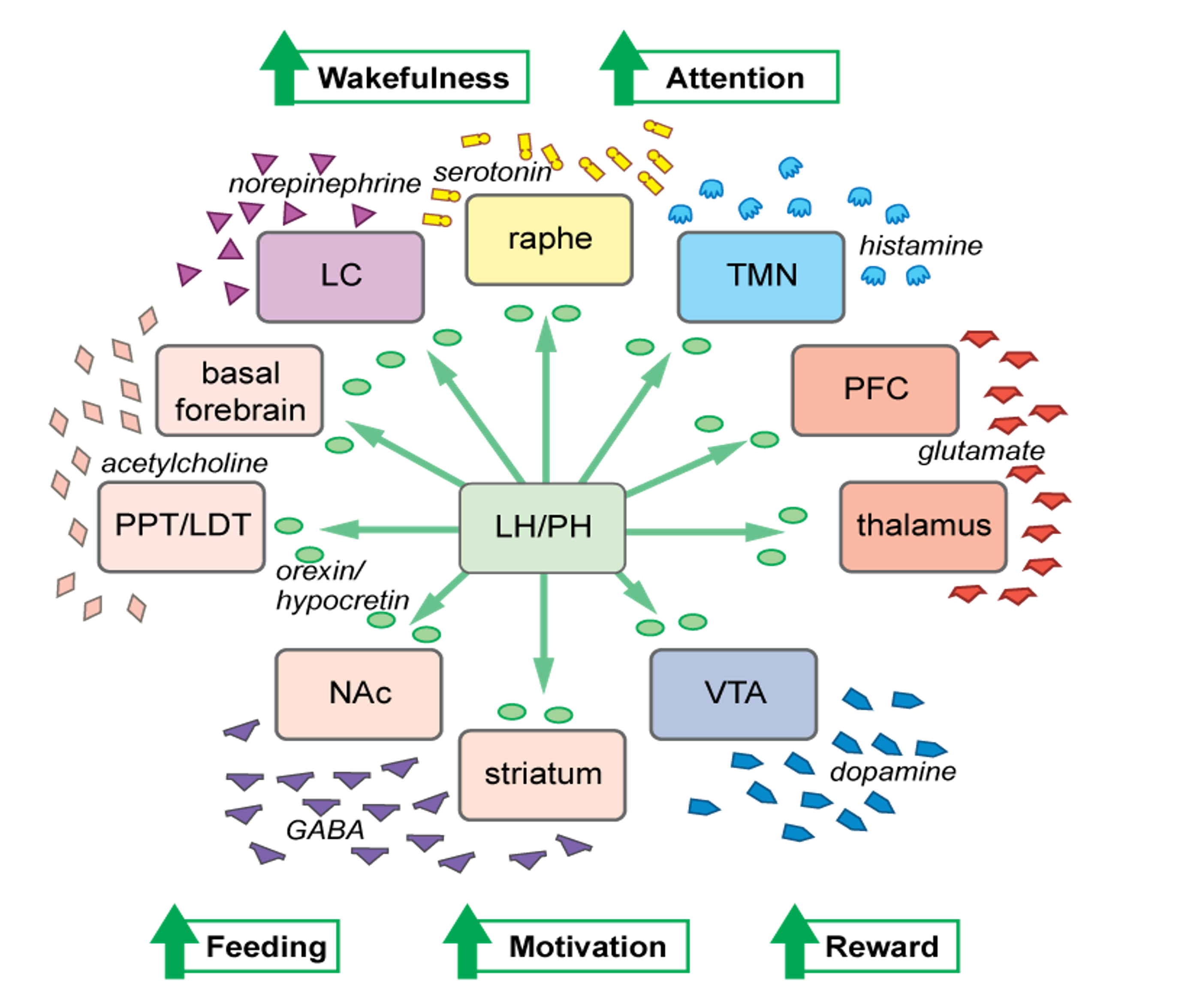
Orexin/hypocretin is released widely in the brain, interacting with all the arousal neurotransmitters to stabilize wakefulness and regulate attention. Orexin is also involved in other behaviors, including feeding, motivation, and reward. LH/PH: lateral hypothalamus/posterior hypothalamus. PPT/LDT: pedunculopontine and laterodorsal tegmental nuclei. LC: locus coeruleus. TMN: tuberomammillary nucleus. PFC: prefrontal cortex. VTA: ventral tegmental area. NAc: nucleus accumbens.
References:
1. Katzman MA, Katzman MP. Neurobiology of the orexin system and its potential role in the regulation of hedonic tone. Brain Sci. 2022;12(2):150. doi:10.3390/brainsci12020150
2. Alkermes plc. Alkermes announces positive phase 1b results demonstrating clinical proof-of-concept for ALKS 7290 in adults with attention-deficit/hyperactivity disorder. Form 8-K, Exhibit 99.1. September 21, 2026.
3. Spencer TJ, Adler LA, Qiao M, et al. Validation of the Adult ADHD Investigator Symptom Rating Scale (AISRS). J Atten Disord. 2010;14(1):57-68. doi:10.1177/1087054709347435
4. ClinicalTrials.gov. A study to evaluate safety and efficacy of ALKS 7290 compared with placebo in adult participants with attention deficit hyperactivity disorder. NCT07755410.