Medication nonadherence is a common contributor to relapse and hospitalization in bipolar I disorder (BD-I). Long-acting injectable antipsychotics (LAIs) provide sustained medication exposure and make missed treatment easier to identify, yet they remain infrequently used in bipolar care and their US Food and Drug Administration (FDA) indications vary by formulation. A new retrospective hospital database analysis compared early rehospitalization after LAI versus oral antipsychotic exposure and found modest associations favoring LAIs, particularly second-generation (SG) formulations.
The study included LAIs used both on- and off-label for bipolar I disorder. The table below summarizes all LAI products with a current FDA indication for maintenance treatment of bipolar I disorder, based on the latest prescribing information. As of August 5, 2026, five branded LAIs across 2 active ingredients carry an adult BD-I maintenance indication. All are approved for maintenance rather than acute mania or bipolar depression. Aripiprazole LAIs are approved as maintenance monotherapy; the risperidone LAIs are approved as monotherapy or adjunctively with lithium or valproate.
FDA-Approved Long-Acting Injectable Antipsychotics for Bipolar I Disorder in Adults
| Active Ingredient / Formulation |
Brand |
FDA-Approved BD-I Use |
BD-I Maintenance Dose |
Initiation and Administration |
| Aripiprazole monohydrate, 1-month IM |
Abilify Maintena |
Maintenance monotherapy |
400 mg monthly; reduce to 300 mg for adverse reactions or certain CYP considerations |
Establish oral tolerability. Start with either 2 separate 400-mg IM injections plus one 20-mg oral dose (1-day initiation), or 1 400-mg IM injection plus 14 days of oral coverage. Deltoid or gluteal. |
| Aripiprazole monohydrate, 2-month IM |
Abilify Asimtufii |
Maintenance monotherapy |
960 mg every 2 months; reduce to 720 mg for adverse reactions or certain CYP considerations |
Establish oral tolerability. Start with either Asimtufii 960 mg + Maintena 400 mg plus one 20-mg oral aripiprazole dose, or Asimtufii plus 14 days of oral coverage. When switching from Maintena, replace the next scheduled dose. Gluteal only. |
| Risperidone microspheres, 2-week IM |
Risperdal Consta |
Maintenance monotherapy or adjunctive therapy to lithium or valproate |
25 mg every 2 weeks; some patients may benefit from 37.5 or 50 mg |
Establish oral tolerability. Continue oral coverage for 3 weeks after the first injection. Deltoid or gluteal. |
| Risperidone microspheres, 2-week IM |
Rykindo |
Maintenance monotherapy or adjunctive therapy to lithium or valproate |
25 mg every 2 weeks; some patients may benefit from 37.5 or 50 mg |
Establish oral tolerability. Continue oral coverage for 7 days after the first injection. Gluteal only. |
| Risperidone suspension, monthly SC |
Uzedy |
Maintenance monotherapy or adjunctive therapy to lithium or valproate |
Monthly: 50, 75, or 100 mg |
Establish oral tolerability. No loading or oral overlap. SC abdomen or upper arm. The every-2-month regimen is not recommended for BD-I. |
Notes: BD-I = bipolar I disorder; CYP = cytochrome P450; IM = intramuscular; SC = subcutaneous. All products are administered by a healthcare professional. This table is a label-level comparison, not a complete prescribing guide; consult the current full prescribing information for dose modifications, missed-dose instructions, interactions, contraindications, warnings, and monitoring.
The current Rykindo and Uzedy labels state that their BD-I effectiveness is based on adequate and well-controlled studies of another risperidone long-acting injection; the bipolar evidence was not generated in formulation-specific efficacy trials.
The efficacy of Abilify Asimtufii (once every 2 month dosing) for the treatment of maintenance monotherapy treatment of bipolar I disorder in adults is based on an adequate and well-controlled study of Abilify Maintena (once monthly dosing).
Study Design and Population
Kaplan and colleagues used the Premier Hospital database to identify adults hospitalized with a primary or admitting BD-I diagnosis between October 2020 and September 2023. Patients needed at least 3 months of baseline and follow-up data. The oral antipsychotic group received an oral agent on the day of or the day before discharge, whereas the LAI group included anyone who received an LAI during the hospital stay. A subgroup of patients on an SG LAI was also identified. The LAI cohort and SG LAI subgroup were propensity-score matched 1:4 with oral antipsychotic cohorts. Outcomes included BD-I-related and all-cause rehospitalization within 30, 60, and 90 days, time to rehospitalization, length of stay, and treatment continuation or switching at the first rehospitalization.
Among 98,088 eligible patients, 76,608 (78.1%) received an oral antipsychotic at discharge and 2,334 (2.4%) received an LAI. The matched analysis included 2,311 LAI-treated patients and 9,244 oral-antipsychotic patients; the SG LAI subgroup included 1,143 patients matched with 4,572 oral-antipsychotic patients. Approximately 91% had another psychiatric comorbidity, about two thirds had a substance-use diagnosis, and approximately 40% had a suicide attempt or presented with suicidal ideation. Importantly, 1,981 of 2,311 LAI-treated patients and all 1,143 patients in the matched SG LAI subgroup were also discharged on oral antipsychotics. The analysis therefore compared LAI exposure, usually with concurrent oral treatment, against oral antipsychotic treatment rather than LAI monotherapy against oral monotherapy.
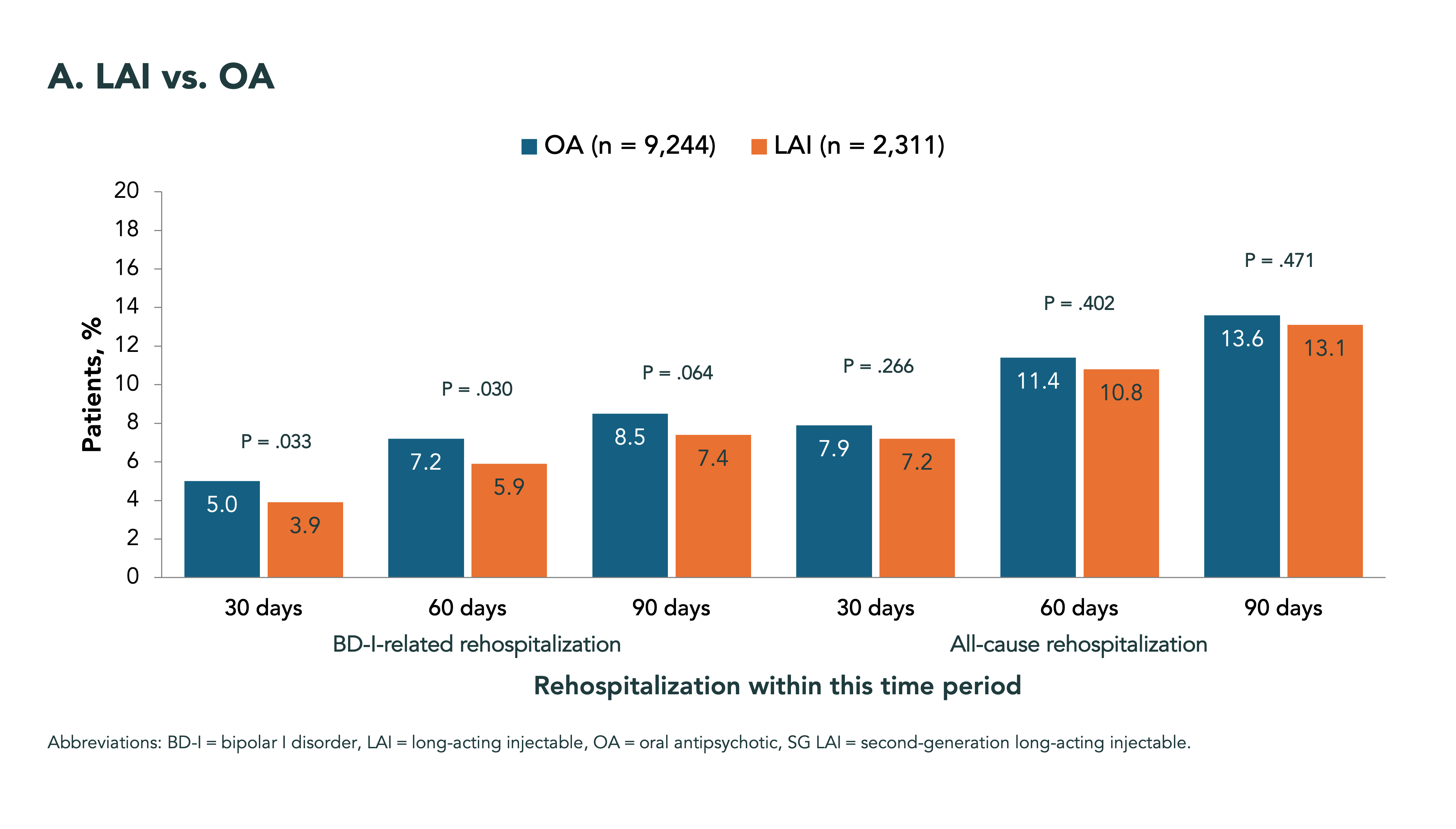
Risk of rehospitalization related to BD-I was lower in the LAI group compared with the oral antipsychotic (OA) group within 30 days (adjusted hazard ratio [HR] 0.784, 95% CI 0.626-0.981) and within 60 days (adjusted HR 0.818, 95% CI 0.680-0.984). The risk was also lower, but not statistically significant, at 90 days (adjusted HR 0.856, 95% CI 0.726-1.011) (Figure 1A).
Figure 1. BD-I-Related and All-Cause Rehospitalization Rates
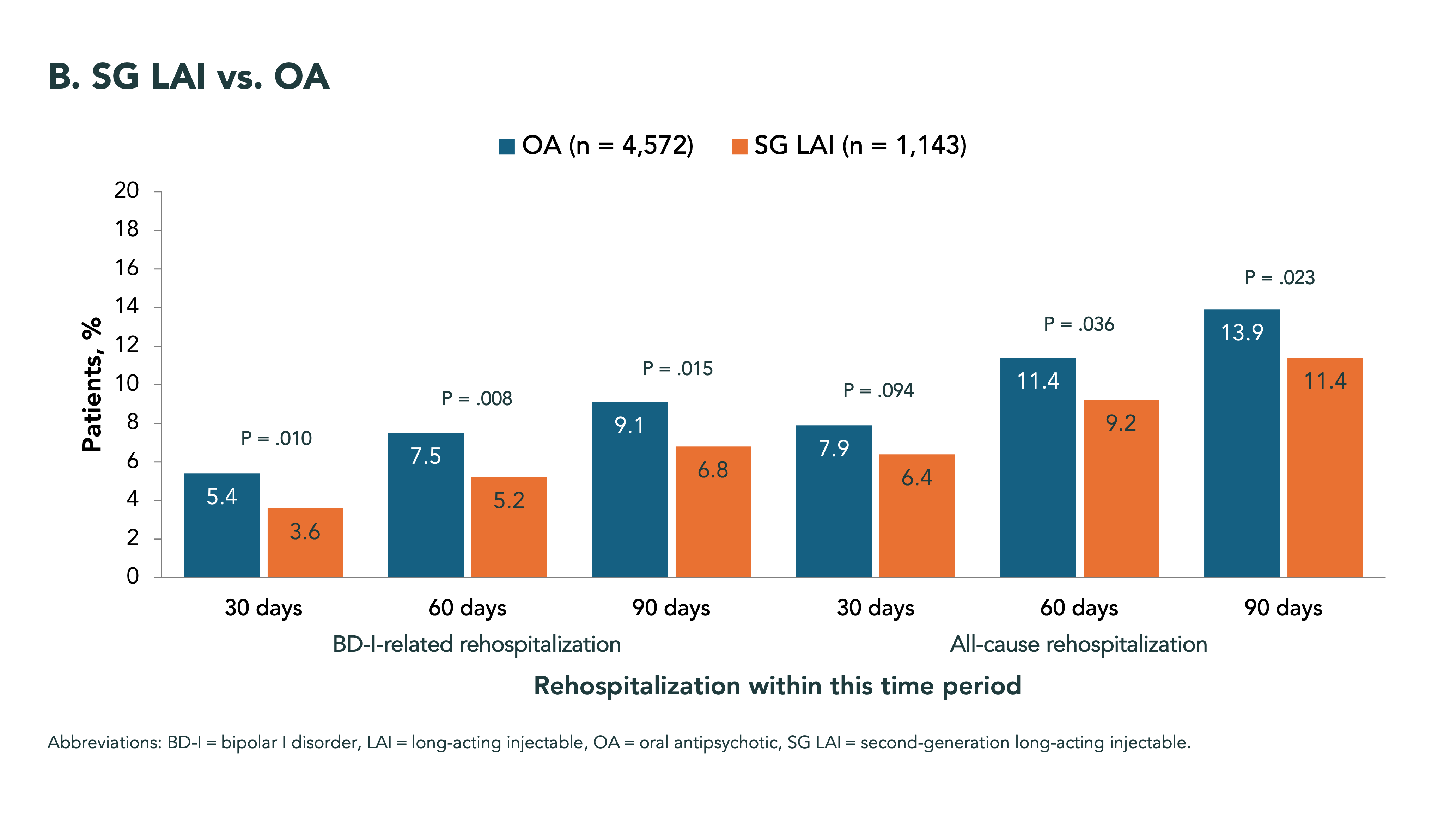
Associations were larger in the SG LAI subgroup (Figure 1B). Risk of rehospitalization related to BD-I was lower in the SG LAI subgroup compared with the OA group within 30 days (adjusted HR 0.653, 95% CI 0.469-0.909), 60 days (adjusted HR 0.692, 95% CI 0.526-0.911), and 90 days (adjusted HR 0.742, 95% CI 0.582-0.945). All-cause rehospitalization was also lower with SG LAIs at 60 days (9.2% vs 11.4%; P = .036) and 90 days (11.4% vs 13.9%; P = .023), but not at 30 days. The authors calculated modest absolute benefits: the 30-day number needed to treat to prevent one BD-I-related rehospitalization was approximately 91 for any LAI and 56 for an SG LAI; by 60 days, the SG LAI number needed to treat was approximately 43. Rehospitalization length of stay was similar between groups.
Treatment persistence at rehospitalization was limited. Across the 30- to 90-day windows, 84.4%-86.4% of patients discharged on oral antipsychotics remained on oral treatment, whereas only 38.9%-41.4% of those discharged on an LAI and 35.4%-37.0% of those discharged on an SG LAI continued an LAI. Exploratory analyses suggested fewer second rehospitalizations among patients who continued their LAI, but most comparisons were not statistically significant and the reasons for switching were unavailable.
The results should be interpreted as associations rather than proof that an LAI prevented rehospitalization. LAI exposure and oral exposure were defined differently; treatment allocation was not randomized; and residual confounding by illness severity, prior treatment, clinician expertise, discharge planning, and patient preference remains possible. The database captured care within the same hospital system but not community treatment, outside hospitalizations, formulary barriers, or actual postdischarge adherence. The 2020-2023 observation period overlapped with the COVID-19 pandemic, multiple comparisons were performed without a formal correction, and diagnostic codes included other or unspecified bipolar diagnoses without requiring a confirming BD-I diagnosis.
The exposure mix also limits product-specific conclusions. In the study's supplementary table, only 565 of 2,334 LAI exposures (24.2%) were classified as on-label at the time: monthly aripiprazole (n = 523) or every-2-week risperidone (n = 42). The remaining exposures were paliperidone (n = 586), olanzapine (n = 1), fluphenazine (n = 312), or haloperidol (n = 870), all classified as off-label for BD-I. The SG LAI result likewise pooled different molecules and cannot establish that every SG formulation, or any single product, reduces rehospitalization.
Despite these limitations, the study provides clinically relevant real-world evidence that LAI treatment may be useful during the high-risk post-discharge period, particularly for patients with recurrent relapse or difficulty sustaining oral treatment. The findings support proactively discussing LAIs as part of shared decision-making, but not a blanket preference for any LAI over oral therapy. Product selection should align with the patient's prior response and tolerability, treatment goals, preferred injection interval and route, ability to complete oral overlap, access to follow-up, and the product-specific FDA indication.
References:
Kaplan S, Dotiwala Z, Casciano J, et al. Outcomes and practice patterns of long-acting injectable versus oral antipsychotics among patients with bipolar I disorder in the United States: a hospital database analysis. J Clin Psychiatry. 2026;87(2):25m16154. doi:10.4088/JCP.25m16154
NEI Prescribe. Neuroscience Education Institute. https://www.neiglobal.com/Members/NEIPrescribeWeb/tabid/448/Default.aspx Accessed August 5, 2026.
Additional Education and Resources: